The matching adjustment, Thames Water, and the question the BPA market is not asking
On regulatory architecture, captured rent, and what happens when an infrastructure asset stops behaving like an infrastructure asset.
On regulatory architecture, captured rent, and what happens when an infrastructure asset stops behaving like an infrastructure asset.
The UK bulk purchase annuity market has become one of the most profitable corners of European insurance. Disclosed new business margins of 8–12% of premium, return on capital in the 12–16% range, and a structural pipeline of corporate defined benefit liabilities that is forecast to drive £50–100bn of annual transaction volume for the next decade. The market is dominated by perhaps eight active writers, all of whom are doing well, and all of whom describe the economics in approximately the same terms: matching adjustment, fundamental spread, risk margin, capital cost, longevity reinsurance, and a modest pricing margin on top. It is a coherent story and it is the story the profession tells itself.
It is also a story that does not bear close inspection on one particular point. The matching adjustment — the regulatory mechanism that permits an insurer to discount its annuity liabilities at risk-free plus an asset spread net of a small fundamental spread — is not just the largest single lever in BPA pricing. It is the lever that determines whether the market exists at all. And the question of how the matching adjustment benefit splits between sponsors and insurers is one the profession has not answered honestly, because answering it would require admitting that a meaningful portion of the disclosed margin is not compensation for risk-bearing but captured regulatory rent.
This article walks through where that captured rent sits, why the trustees agreeing buy-out deals cannot see it, and what Thames Water tells us about the assumption the whole structure rests on. It is written from inside the profession rather than against it, but with the conviction that intellectual honesty is overdue.
The valuation stack
A defined benefit pension scheme transferring to an insurer faces not one valuation of its liabilities but five, and the gap between the lowest and the highest can be 30% or more. The scheme actuary values the liabilities on a funding basis — typically gilts plus a margin of 50–150bp depending on covenant strength — to set sponsor contribution rates. The sponsor reports the same liabilities on an IAS 19 basis using AA corporate bond yields. The insurer values them on a Solvency II best-estimate basis using the risk-free swap curve. The insurer then applies the matching adjustment, pulling the discount rate up by 60–120bp and the liability value down by 13–15%. The Solvency II risk margin is added on top. The buy-out premium quoted to the sponsor sits at the top of the stack.
The diagram below maps these tiers using illustrative numbers. The scheme thinks the liabilities are worth £900m. The IAS 19 number is £950m. The Solvency II best estimate before the matching adjustment is £1.15bn — the insurer’s view of the liabilities valued at risk-free, with insurer-grade mortality and full longevity improvement assumptions. The matching adjustment pulls this back to £1.00bn. The risk margin takes it to £1.04bn. The premium quoted to the sponsor is £1.05bn.
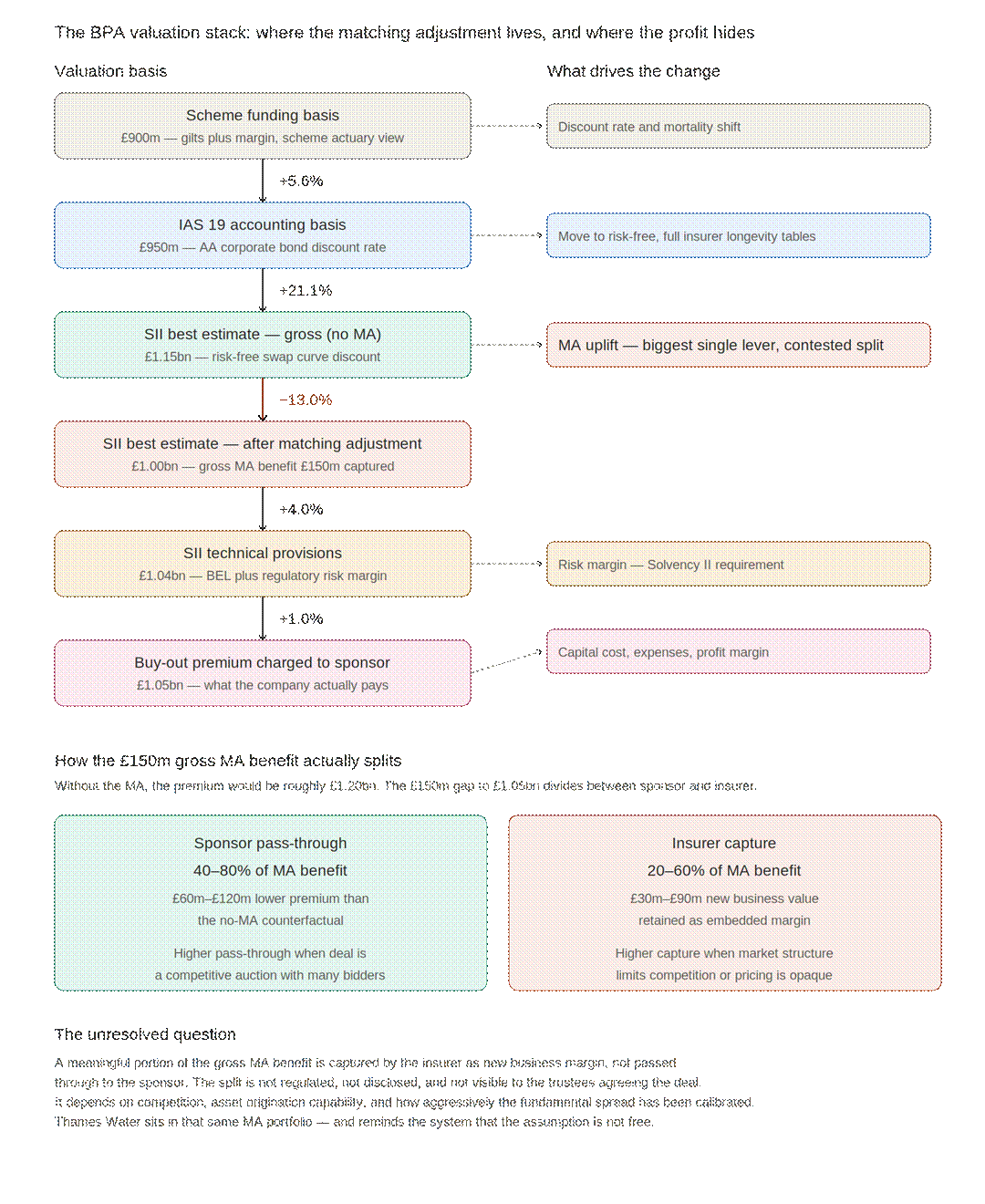
Figure 1. Valuation stack from scheme funding to buy-out premium, with the £150m gross matching adjustment benefit and the contested sponsor / insurer split.
The thing to notice is the −13.0% step. Without the matching adjustment, the insurer would have to price the deal off a Solvency II best estimate of £1.15bn rather than £1.00bn. Add the risk margin and the profit loading, and the buy-out premium would be roughly £1.20bn rather than £1.05bn. The matching adjustment is doing £150m of work on a £1bn deal. Without it, BPA pricing would be unaffordable to most sponsors and the market would not exist at the scale we observe. The PRA knows this; the insurers know it; the profession quietly knows it. The question is how that £150m benefit divides between the sponsor and the insurer.
Where the £150m actually goes
The insurer’s pricing model embeds the matching adjustment in the discount rate. Mechanically, the lower discount rate produces a lower liability PV, which feeds into a lower premium. So the sponsor benefits — the £1.05bn premium is lower than the £1.20bn no-MA counterfactual by roughly £150m. In the narrowest sense, the matching adjustment is passed through.
Except that the £1.20bn counterfactual is theoretical. No sponsor has ever paid a buy-out premium calculated without the matching adjustment, because the matching adjustment has existed since Solvency II came in. The "without MA" price is what the insurer’s internal model spits out when the MA is switched off. It is not a market price. So the claim that the sponsor captures the full £150m is technically true but operationally untestable.
What is testable is the disclosed new business margin. L&G, Aviva, Phoenix, and Just all report BPA new business margins of 8–12% of premium. On a £1.05bn deal, that is £80–125m of present-value profit captured at point of sale, against perhaps £80–120m of capital deployed. A meaningful portion of that margin is genuinely earned: longevity risk-bearing compensation, expense efficiency, capital cost, and the residual underwriting margin that competitive markets allow. But a meaningful portion is also matching adjustment economics that did not pass through to the sponsor.
Three structural features prevent the full MA benefit from being competed away into lower premiums. First, the matching adjustment is a common input across all major UK BPA writers. They all hold broadly similar asset portfolios, they all face the same fundamental spread regime, they all calculate broadly similar gross MA benefits. The MA is therefore not a competitive differentiator — it is a shared floor that all insurers embed in their pricing without competition eroding it. Competition happens on the other inputs: mortality, expense efficiency, target IRR, willingness to win the deal. The MA benefit sits in a common pool that the market collectively retains.
Second, trustees price-discover from quotes, not from cost. The trustees and their advisors see the quoted premiums from competing insurers. They benchmark against each other and against historical comparables. What they do not see is the insurer’s actual portfolio yield, the fundamental spread allocation, the expected default experience, or the embedded MA benefit. The insurer prices using full information; the trustees price-discover from outputs. The asymmetry allows insurers to capture more of the MA benefit than a transparent market would.
Third, the market is oligopolistic. Eight active writers for large deals, perhaps five seriously competitive on any given £1bn-plus tender. New entrants face structural barriers — asset origination capability takes a decade to build, internal models take years to get approved, distribution relationships are sticky. The competitive pressure on pricing is real but limited, and the equilibrium margin that survives is materially above marginal cost.
The honest range is that the sponsor pass-through is somewhere between 40% and 80% of the gross matching adjustment benefit. The insurer captures the rest — £30m to £90m on a £1bn deal — as embedded new business margin that the trustees cannot see and the market structure does not compete away.
This is not a scandal. It is not even unusual. Markets with high fixed costs, regulatory complexity, and asymmetric information consistently produce margins above marginal cost. The point is that the profession’s comfortable framing — "the matching adjustment is the regulatory subsidy that makes the market work and the benefit flows to sponsors" — is incomplete. A significant portion of the benefit flows to insurers, the split is not regulated or disclosed, and the regulatory architecture is doing the heavy lifting that competition would otherwise do.
The asset side: private credit and uneven access
The matching adjustment benefit depends entirely on the asset portfolio assumed to back the liabilities. A portfolio of pure gilts produces no MA benefit at all — there is no spread above the swap curve to claim. A portfolio of investment-grade public corporates produces roughly 150bp of MA benefit. A portfolio that includes infrastructure debt, equity release mortgages, private placements, and direct lending to mid-market companies can produce 400–500bp. The yield-hungriness of BPA insurers is not retail-style reaching for yield — it is structurally driven by the MA mechanism. Every additional basis point of asset spread, net of the fundamental spread, becomes an additional basis point of liability discount.
This is why private credit origination capability has become the binding competitive constraint in BPA. An insurer that can source long-dated private credit at scale, through an affiliated asset manager, prices BPA deals with full MA benefit assumed on a defensible portfolio it controls. An insurer that cannot source such assets has to either assume a portfolio yielding less, accept tighter pricing, or access origination through external partners and pay away the spread economics. The pricing difference between a top-tier originator and a marginal one on the same deal can be 3–5% of premium — entirely attributable to the asset platform, not the liability assessment.
Access to this capability is structurally uneven. L&G has been originating infrastructure debt and private placements through LGIM for fifteen years, since well before BPA became the dominant strategic priority. Aviva Investors has decades of UK commercial property debt experience. M&G inherited a substantial private credit and real estate debt platform from the Prudential heritage. PIC and Rothesay built specialist in-house origination teams. Just Group built its capability around equity release mortgages, originating directly to retail borrowers through its lifetime mortgage business. These are multi-decade institutional capabilities with deal sourcing networks, underwriting teams, structuring expertise, and asset-liability integration that cannot be replicated quickly. The investment is measured in years and hundreds of millions of pounds.
New entrants face a structural choice. They can build origination organically and accept several years of competitive disadvantage. They can partner with external private credit GPs and pay management fees that compress the captured spread. Or they can access origination through funded reinsurance to a US-affiliated platform — typically a Bermuda-domiciled vehicle owned by, or partnered with, an Apollo, KKR, Brookfield, or Sixth Street-scale asset manager whose global private credit origination capability can be imported into the UK BPA economics through the reinsurance structure. The third option has been the dominant growth mechanism for new entrants since 2020.
The uneven access creates a market structure that is not what it appears. The eight or so active BPA writers are not competing on equal asset platforms. They are competing on liabilities they all understand similarly, against asset portfolios that differ materially in quality, diversification, and credit experience. The matching adjustment treats these portfolios as broadly equivalent through the fundamental spread mechanism, but the underlying credit risk is not equivalent. An insurer with deep direct origination, strong underwriting capability, and a long track record of cycle-tested credit decisions holds a different real risk profile than an insurer relying on offshore counterparties to deliver assets sourced through structures the UK regulator can see only imperfectly.
The systemic concern follows directly. If the BPA market’s headline economics depend on private credit asset portfolios, and access to those portfolios is unevenly distributed, and the cheapest path to access runs through offshore reinsurance arrangements with related-party origination, then the market is growing in a way that concentrates credit underwriting in a small number of asset platforms whose interests are not fully aligned with the UK insurance balance sheets bearing the ultimate liability. The matching adjustment benefit claimed by the UK insurer is fed by assets originated, in many cases, by a US-affiliated platform earning origination fees, asset management fees, and spread economics on the ceded portion. Whether the loans are priced fairly to the eventual insurance balance sheet — rather than to maximise the originator’s captured economics — is a question the regulatory framework cannot easily answer.
Thames Water and the assumption beneath the assumption
The matching adjustment framework rests on a specific empirical assumption: that the asset portfolio backing the annuity liabilities will earn its expected spread net of defaults over the 40–60 year run-off. The fundamental spread set by the PRA is intended to capture the cost of credit risk borne by the insurer. If the FS is correctly calibrated, the matching adjustment benefit above the FS is fair compensation for illiquidity. If the FS is too low, the matching adjustment benefit is partly captured rent. If the underlying asset turns out to bear credit risk the framework did not contemplate, the entire chain of assumptions fails.
"Infrastructure debt" is the asset class that makes this question concrete. The label sounds reassuring. Regulated utilities, social infrastructure, transport, renewable energy — long-dated, cashflow-predictable, secured against real assets, supported by government or regulator-set returns. Exactly the kind of asset the matching adjustment framework was designed to encourage insurers to hold. UK BPA insurer general accounts hold tens of billions of pounds of infrastructure debt, much of it private placement format, much of it rated by the agencies as investment grade, much of it claiming the favourable MA treatment that comes with cashflow-predictable hold-to-maturity assets.
Thames Water was, until recently, exactly this kind of asset. Long-dated regulated utility debt, investment grade, held in UK pension and insurance portfolios as core matching-adjustment-eligible exposure. The Ofwat regulatory framework provided the cashflow predictability. The asset met the eligibility tests. The fundamental spread applied to it was modest. The matching adjustment benefit claimed by holders was substantial. The asset behaved as the framework expected — until it did not.
Through 2023–24, Thames Water’s position deteriorated catastrophically. Equity holders faced wipe-out. Debt was restructured, ratings cut into sub-investment grade, the regulatory framework itself became contested as Ofwat’s capacity to set economic returns ran into the political reality of consumer prices, environmental obligations, and a £20bn-plus capital expenditure backlog. Government intervention and special administration were openly discussed. The asset that the matching adjustment framework treated as predictable infrastructure debt became, in slow motion, distressed credit.
What does this mean mechanically for a BPA insurer holding Thames Water debt? Several things. The MA eligibility of the holding becomes uncertain — if downgraded out of investment grade, eligibility can be lost entirely, forcing the insurer to revalue the corresponding portion of the liability at a much higher PV and producing an immediate Solvency II capital hit. The fundamental spread applied to the asset rises sharply, compressing the MA benefit even where the asset remains eligible. The portfolio that was assumed to generate predictable spread starts generating uncertain restructured cashflows with material credit risk. The "spread above the FS" that the insurer was earning as profit shrinks, disappears, or becomes negative.
Thames Water is being managed without systemic consequence because it is one asset in diversified portfolios. The point is not that it broke the system. The point is that the framework assumed it could not break in the way it did — and the framework was wrong.
The matching adjustment treats infrastructure debt uniformly through the fundamental spread mechanism, but the asset class contains enormous variation. Regulated utilities depend on the regulatory framework holding; availability-based PPP depends on the underlying government covenant and contractor solvency; demand-based infrastructure has genuine commercial risk; renewable project debt depends on power prices and resource assumptions; greenfield construction debt has completion risk. Bundling these under "infrastructure" and applying broadly similar MA treatment is a category error that the asset class label obscures. Thames Water is the visible failure; the next one will look different but will come from the same structural place.
Direct lending to PE-sponsored mid-market companies — the asset class most analogous to leveraged loans — has experienced default rates of 1–3% in the benign conditions of the past decade. A genuine credit cycle would plausibly produce default rates of 5–8% with materially lower recoveries. Whether the fundamental spread captures this distribution of outcomes, or only the central scenario, is a question that will be answered by the next downturn rather than by present analysis. Equity release mortgages depend on UK house price assumptions, longevity assumptions, and the PRA’s effective value test methodology — three sources of correlated regulatory and demographic risk that the matching adjustment treatment compresses into a single eligibility decision. Asset-based finance, real estate debt, structured credit — each carries its own version of the same problem. The framework treats the asset class label as the unit of analysis; the credit reality is far more granular than the label admits.
The balance sheet side: funded reinsurance and concentration
The matching adjustment determines how the liability is valued. Funded reinsurance determines which balance sheet ends up holding the assets and the capital required against them. The two mechanisms operate on different sides of the BPA economics but interact directly, and the combination is what produces the disclosed return on capital that makes the market attractive to shareholders.
The structure is straightforward. A UK BPA insurer cedes a portion of a BPA liability — typically 30–70% — to an offshore reinsurer, usually Bermuda-domiciled, often affiliated with a US private credit platform. The reinsurer posts collateral, typically the assets backing the ceded liability, into a trust or collateral account. The UK insurer receives capital relief under Solvency II because the ceded risk no longer requires SCR backing on its balance sheet. The Bermuda reinsurer holds the assets under the BMA’s commercial reinsurer regime, which applies materially lighter capital requirements than Solvency II for several asset classes — particularly private credit, asset-based finance, structured credit, and CLO equity tranches. The capital arbitrage between the two regulatory regimes is real, and the insurer captures it as improved return on the residual capital deployed.
The economic effect on the disclosed economics is substantial. A BPA deal that requires £120m of capital on a fully retained basis can require £60m or less with 50% funded reinsurance, while sacrificing only 10–15% of the present-value profit. The IRR on capital rises from roughly 10% to roughly 14%. For shareholders, who care about return on capital rather than absolute profit, funded reinsurance is unambiguously value-accretive on the disclosed measures. At industry scale, with roughly 40–50% of UK BPA new business volume currently backed by funded reinsurance structures, the aggregate capital release across the market is in the region of £4–6bn per year. That released capital is recycled into writing more BPA volume, which is a meaningful component of why the supply side of the market has been able to scale from £20bn per year to £50bn per year in less than a decade.
What the structure does not transfer is the legal obligation to the pensioner. The UK insurer remains the policyholder-facing obligor. If the Bermuda reinsurer fails, the liability does not extinguish — it recaptures back onto the UK insurer’s balance sheet, at exactly the moment when the UK insurer is least able to absorb it. The collateral arrangements are designed to mitigate this, but collateral is only as good as the assets backing it, and the assets in question are often the same private credit positions whose distressed performance triggered the reinsurer’s failure in the first place. The risk transfer that funded reinsurance is described as providing is partial — the asset and longevity risk move offshore, the legal obligation does not, and the residual recapture risk concentrates in the UK insurer balance sheets that the structure was supposed to relieve.
The concentration of these offshore counterparties is the systemic concern. UK BPA funded reinsurance is currently spread across roughly six Bermuda-domiciled entities, several of them affiliated with US private credit megaplatforms — Apollo-Athene, KKR-Global Atlantic, Brookfield-AEL, Sixth Street-Talcott, and a small number of others. If a single major counterparty fails, the recapture risk cascades across multiple UK insurers simultaneously. The systemic event is not a credit cycle alone — it is an offshore counterparty failure correlated with credit stress, hitting the UK insurance system through a small number of concentrated exposures that look like risk transfer on the surface but resolve as concentrated counterparty risk under stress.
The vertical integration angle compounds the concern. When the Bermuda reinsurer is owned by the same group as the private credit platform originating the assets, the captive structure means the origination economics, the asset management fees, and the spread captured on the ceded portion all flow within the same corporate boundary. The loans backing the ceded liability are priced by a related party, marked by a related party, and rated, increasingly, by smaller NRSROs whose methodologies have not been cycle-tested. The PRA’s Dear CEO letter of April 2024, the CP24/23 consultation, and the ongoing SS20/16 update are all pointed at exactly this complex of issues. The regulatory direction is to tighten collateral quality requirements, impose concentration limits, require more granular reporting on the underlying assets, and apply Pillar 2 capital add-ons where the cession looks like pure regulatory arbitrage rather than genuine risk transfer. The expectation is that funded reinsurance is not going away but that the IRR uplift it provides will compress as the regulatory cost rises.
Bringing the two mechanisms together: the matching adjustment generates a liability discount whose distribution between sponsor and insurer is contested; funded reinsurance generates a capital relief whose underlying risk transfer is partial and concentrated; both depend on regulatory frameworks whose calibration has not been cycle-tested. The combined effect is a BPA return on capital that looks attractive to shareholders but rests on a stack of regulatory assumptions that are individually defensible and collectively fragile. Remove the matching adjustment and the market does not exist. Remove funded reinsurance and the disclosed returns fall by three to five percentage points. Tighten the fundamental spread on private credit and back-book margins compress. Each lever is a regulatory choice; together they constitute the architecture on which the market’s profitability depends.
The harder question
Bring the threads together. The matching adjustment is generating £150m of liability discount on a £1bn BPA deal. Roughly £30–90m of that is captured by the insurer as embedded margin that the sponsor and trustees cannot see. The captured margin is justified, in the regulatory framing, as compensation for bearing the long-tail credit risk on the asset portfolio that backs the annuity. The fundamental spread is supposed to ensure that the captured margin reflects only true illiquidity premium and not credit risk that should be reserved against. The asset portfolio itself is unevenly sourced across the market, with some insurers originating in-house and others importing origination through funded reinsurance to offshore platforms. The capital required to hold the residual risk is reduced, often substantially, through that same funded reinsurance, transferring assets and longevity risk to balance sheets operating under lighter regulatory regimes while retaining the legal obligation to the pensioner.
Thames Water is the case study that asks whether any of these layered assumptions hold. The fundamental spread for investment-grade utility debt is calibrated to a default-and-downgrade experience that did not contemplate the Thames Water failure mode. If the FS undershoots actual credit experience by 50–100bp over a cycle — for infrastructure, for direct lending, for ERMs, for real estate debt — the captured margin that insurers have been recognising as new business profit turns out to have been credit risk that should have been reserved. The recognition reverses; the back-book deteriorates; the disclosed margins compress. The insurer that originated the assets in-house, with cycle-tested credit judgement, absorbs the deterioration with greater resilience. The insurer that imported origination through a funded reinsurance arrangement faces the same credit deterioration plus the counterparty exposure to whether the offshore reinsurer can absorb it, plus the recapture risk if the reinsurer cannot.
This is the failure mode the profession does not want to think about, because the answer to "is the fundamental spread correctly calibrated, on a portfolio that varies by insurer, held partly through reinsurance arrangements of uneven quality?" cannot be known until the cycle plays out. A benign credit environment makes the framework look conservative; a real credit cycle reveals whether the conservatism was real or only apparent. The 2010s and early 2020s have been a benign credit environment with substantial central bank support. The next decade may not be.
The systemic risk is not a 2008-style cascade — leverage in the insurance system is genuinely lower, liquidity mismatch is genuinely smaller, the resolution framework is genuinely better designed. The risk is slower and quieter: a credit cycle that produces sustained losses above the fundamental spread, eroding back-book profitability across the industry, combined with funded reinsurance counterparty concentration that turns idiosyncratic offshore failures into UK insurer recapture events, against a regulatory framework that has been progressively expanding MA eligibility under Solvency UK while the FPC and the PRA grow increasingly uneasy about exactly that expansion. The credit losses, the counterparty failures, and the regulatory adjustments would unfold over years rather than weeks. The cumulative damage would be material; the failure mode would not be sudden.
What honest practice looks like
None of this argues against BPA, against the matching adjustment, or against private credit as an asset class for insurance balance sheets. The market is providing a real service — extinguishing sponsor liabilities, securing pensioner benefits, and channelling long-term savings into productive investment in infrastructure and corporate credit. The economics work because the regulatory framework permits them to work, and the framework permits it because the alternative — a UK pensions system where £1.4 trillion of DB liabilities cannot find an insurance home — is materially worse.
What it argues for is honesty about what the framework is doing. The matching adjustment is not a passive technical mechanism; it is an active regulatory subsidy whose distribution between sponsors and insurers is contested, not settled. The captured margin is not pure compensation for risk-bearing; a meaningful portion of it is rent that survives because the market structure does not compete it away. The fundamental spread is not empirically validated; it is a regulatory choice whose adequacy will be tested by the next credit cycle. Access to private credit origination is not uniform across the market; it is concentrated in a small number of insurers with multi-decade institutional capability, while new entrants increasingly source origination through offshore reinsurance arrangements whose related-party economics the regulator can see only imperfectly. Funded reinsurance is not pure risk transfer; the legal obligation to the pensioner remains with the UK insurer, and the structural concentration of offshore counterparties means that idiosyncratic failures would resolve as systemic recapture events. Thames Water is not an outlier; it is an early signal that asset classes treated as predictable can stop being predictable, and the framework needs to expect this rather than be surprised by it.
For trustees and their advisors, the practical implication is to ask harder questions about the insurer’s asset portfolio composition, fundamental spread allocation, expected default experience, origination provenance, and reinsurance counterparty exposures — not to second-guess the pricing, but to understand the assumptions embedded in it. For the profession, it is to write about the captured margin, the uneven origination, and the funded reinsurance concentration candidly rather than to keep deferring the questions. For the PRA, it is to continue tightening fundamental spread calibration on the asset classes where the regulatory subsidy looks most generous, and to constrain the funded reinsurance structures that magnify the regulatory arbitrage. For BPA insurers, it is to recognise that the current margin structure is contingent on regulatory stability, benign credit conditions, and counterparty solvency, none of which are guaranteed over a 10-year horizon.
The market is profitable, growing, and structurally important. It is also operating with assumptions that have not been cycle-tested, a regulatory subsidy whose distribution is not fully passed through, an asset platform whose quality varies materially across writers, and a reinsurance architecture whose risk transfer is partial and concentrated. All of these can be true at once. The profession’s job is to say so clearly, not to wait for Thames Water to become a category rather than a single name before the conversation gets honest.