The Triple Lock - Part 2 - The Invisible Subsidy
What public-sector pensions are really worth — and why almost nobody counts
In 2015, the government told the country it had ended the era of gold-plated public-sector pensions. The reforms that followed the Hutton Review closed the old final-salary schemes and replaced them with something called Career Average Revalued Earnings. The language alone — “career average,” “reform,” “modernisation” — did the political work. It sounded like restraint. It sounded like the public sector had finally been brought into line with everyone else.
It had not.
What actually happened is that the NHS, teachers, the civil service, the armed forces and the judiciary all moved from one kind of defined benefit pension to another kind of defined benefit pension. The guarantee survived intact. The taxpayer backing survived intact. The inflation protection survived intact. What changed was the formula for calculating the benefit, not the nature of the promise. And in some respects the new schemes are more generous than the ones they replaced.
The private sector, meanwhile, had already been quietly stripped of defined benefit pensions altogether. Most large private employers closed their final-salary schemes to new members between 2000 and 2015 and replaced them with defined contribution arrangements — a pot of money, exposed to markets, with no guarantee of anything. The two halves of the workforce now retire under fundamentally different rules, and the gap between them is not a matter of degree. It is a matter of kind.
This is not an argument that public servants are overpaid or undeserving. It is an argument that the value of what they receive in retirement is enormous, largely invisible, and paid for by a private-sector workforce that has no equivalent. The debate about pension fairness is conducted in near-total ignorance of the numbers. So let us count.
Two kinds of promise
A defined contribution pension is a savings account with tax relief. You and your employer pay in; the money is invested; and at retirement you have whatever the pot is worth. If markets crash the year before you stop work, that is your problem. If you live longer than your money lasts, that is your problem. If inflation erodes the real value of your income through a thirty-year retirement, that too is your problem. You carry the investment risk, the longevity risk and the inflation risk personally, all the way through.
A defined benefit pension is a promise of income. You are told, by formula, exactly what you will receive each year in retirement, for the rest of your life, rising with inflation, regardless of what markets do. You carry none of the three risks. The scheme — and behind it, the taxpayer — carries all of them.
These are not two flavours of the same thing. They are different financial instruments. One is a quantity of savings; the other is a guaranteed, indexed, lifelong income stream. And the second is worth dramatically more than the first, for reasons that become obvious the moment you try to price them on the same scale.
The factor of sixteen
The whole argument that follows turns on a single number, so it is worth setting it out carefully. The number is sixteen, and it is the actuarial machinery that converts “a guaranteed annual income” into “a lump sum of equivalent value.” It is the same factor HMRC itself uses to test public-sector pensions against the annual allowance. And it is the single most clarifying figure in the entire debate, because it turns the invisible visible.
The logic is this. If you wanted to buy a guaranteed, inflation-linked income for life on the open market — an index-linked annuity, the closest commercial equivalent of a defined benefit pension — you would have to hand an insurer a very large capital sum. As a rule of thumb, roughly sixteen times the annual income you wanted, and arguably more when interest rates are low. So an annual pension of £10,000 represents about £160,000 of capital value. The factor is not a tax rate. It is not a penalty. It is an exchange rate — a translation between two different units of measure: income for life on one side, money in the bank on the other.
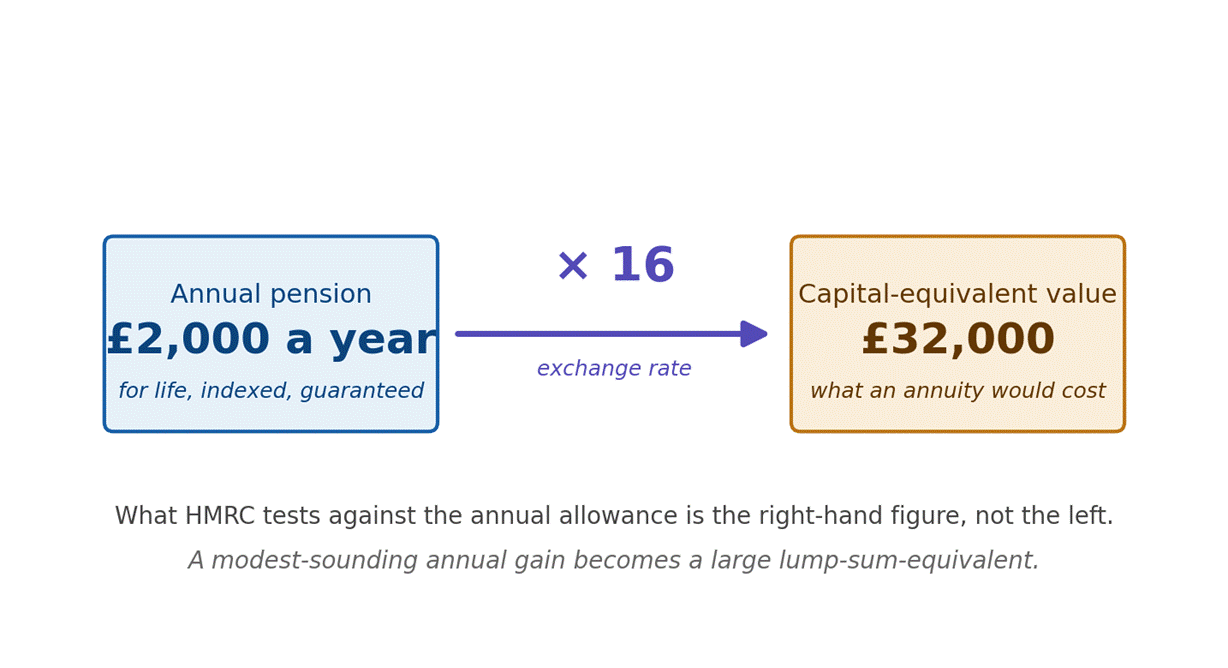
Figure 1. The factor of sixteen as an exchange rate. A modest annual pension converts to a much larger capital-equivalent value, because guaranteed inflation-linked income for life is genuinely expensive to buy.
The analogy that makes it click is a rental property. If your buy-to-let’s rent rises by £2,000 a year, that does not sound like much. But the property itself has just become worth perhaps £40,000 more, because the asset is valued as a multiple of its annual income. Nobody objects to that maths; everybody accepts that a small annual figure can imply a large capital uplift when the income is reliable. The factor of sixteen is doing exactly the same job for a pension. It values the entitlement as an asset — a multiple of its annual income — rather than as a yearly cash figure. The asset has not been invented; it was always there. What the factor does is make it countable.
This matters because the temptation in any pension debate is to talk about annual pension figures, which sound small. “A single year of service banks roughly £2,000 of annual pension” is a sentence that triggers no alarm. “A single year of service deposits roughly £32,000 of capital-equivalent value, risk-free, at public expense” is the same sentence, told honestly. The factor of sixteen is what closes the gap between the two.
Where the factor is contested — and why it survives the challenges
No serious account would defend the factor of sixteen as flawless, and an honest one has to admit where it is contested. There are three substantive challenges.
The first is that sixteen is a flat factor that does not move with circumstances. The true cost of replicating a pound of guaranteed indexed income depends on interest rates, the recipient’s age, and life expectancy. In a low-rate environment the genuine market cost is meaningfully higher than sixteen times; in a high-rate environment it is lower. A flat conversion factor is necessarily a rough average, and reasonable people argue about which way it errs.
The second is that the factor was set by HMRC primarily for administrative purposes — to give a workable comparator against the annual allowance — not as a definitive actuarial valuation. Actuarial cash equivalent transfer values, which schemes use when members move pensions between arrangements, frequently come out higher than sixteen times, especially for younger members with long durations ahead of them. By that yardstick the factor understates the true value.
The third is that even sixteen times the income does not capture the risk transfer. A defined benefit pension is not just guaranteed income; it is the complete removal of investment risk, longevity risk, and inflation risk from the member. To replicate that bundle of guarantees a private saver would need not just a large pot but also an insurance product, which carries its own loadings. The factor priced against an index-linked annuity captures most of this, but probably not all of it.
Notice what all three challenges have in common. They suggest the factor may be too low — that the true value of a defined benefit pension is, if anything, greater than sixteen times its annual income. The challenges critics raise are challenges from the high side, not the low. There is no respectable line of argument that the factor materially overstates DB value. Which means that when the factor is used in the analysis that follows, the figures it produces should be read as conservative. The real subsidy is at least this large; it is probably larger.
What a career actually accrues
Take the schemes as they now stand, all built on the same career-average template, and look at how much pension each one banks for every year worked:
The judiciary accrues fastest, at 2.5% of pensionable pay each year — roughly one fortieth. The civil service alpha scheme runs at about 2.32%, near one forty-third. The armed forces accrue one forty-seventh, the NHS one fifty-fourth, and teachers one fifty-seventh. Each of those annual slices is then revalued every year — for active members, at inflation plus a margin: teachers at CPI plus 1.6%, the NHS at CPI plus 1.5%, the armed forces at CPI plus 1% on top of an earnings-linked uplift. The “plus” matters enormously. It means the pension grows faster than inflation every single year you remain in service, compounding across a career into something that can exceed a real-terms doubling of what you originally banked.
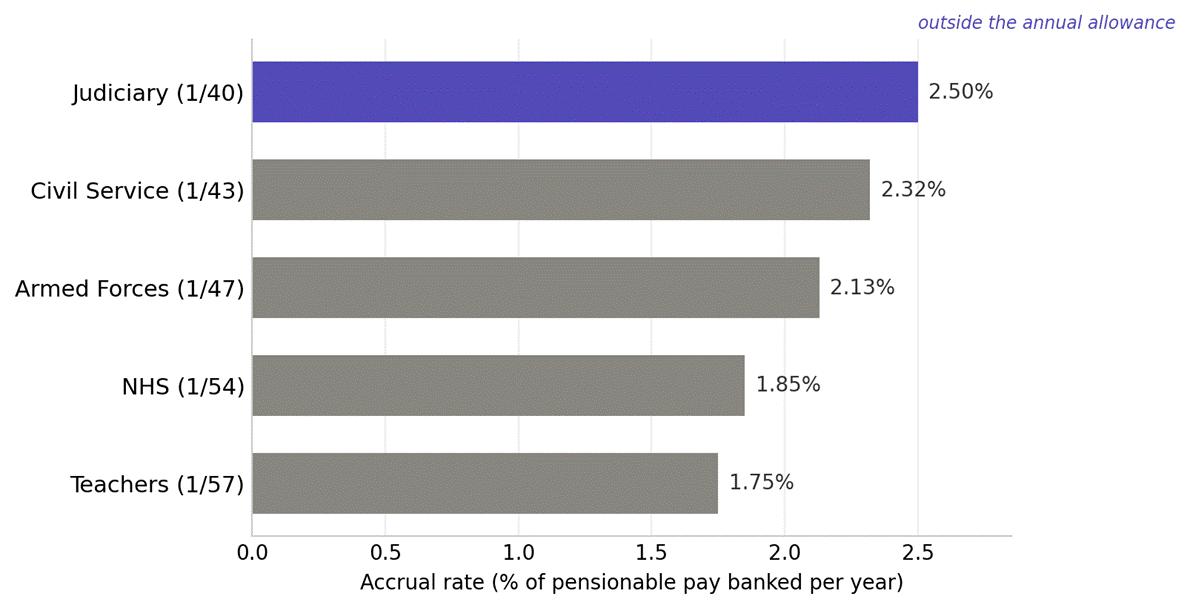
Figure 2. Accrual rate by scheme. The judiciary accrues fastest and uniquely sits outside the annual allowance (shown in purple).
Consider a consultant, a headteacher, a senior civil servant — anyone on a salary around £110,000 in a one-fifty-fourth scheme. A single year of service banks roughly £2,000 of annual pension. That sounds trivial. But that £2,000 a year is income for life, indexed, guaranteed. At a factor of sixteen, that one year of work has just generated around £32,000 of capital-equivalent value. And that is before the revaluation uplift on everything previously accrued, which in a high-inflation year can add as much again.
Now set that beside the private-sector comparator. An employee on the same £110,000 in a typical defined contribution scheme might receive an employer contribution of eight per cent — £8,800 — into a pot they must invest themselves, bearing every risk, with no guarantee that it will ever produce a reliable income. The public servant receives, in equivalent value, something in the order of three to seven times as much, with all the risk removed. That is the subsidy. It is real, it is large, and it appears on nobody’s payslip.
Who pays, and the trick of the unfunded scheme
The schemes for the NHS, teachers, civil service, armed forces and judiciary share one further feature that the public almost never registers: they are unfunded. There is no invested pot of money standing behind them. The “employer contribution” — over 14% of pay in the NHS, around 27% in the civil service — is a notional accounting entry, not real money set aside and invested. The pensions actually being paid to today’s retirees are met directly from today’s taxation.
This is the part that should give pause. A funded private-sector scheme at least has assets behind it; the risk is borne by markets and members. An unfunded public-sector scheme has only one backstop: the future taxpayer. Every promise made today is a claim on the earnings of tomorrow’s workers — including the very private-sector employees whose own pensions carry no guarantee whatsoever. The accounting liability of the NHS scheme alone stood at around £457 billion as of March 2025. That is not a fund. It is an IOU written against future general taxation.
So the structure is this: a private-sector worker on a defined contribution pension, bearing all their own retirement risk, is also — through their taxes — underwriting the guaranteed, risk-free, inflation-proofed retirement of public-sector colleagues on comparable salaries. The subsidy flows from the less-protected to the more-protected. Whatever one thinks of that arrangement, it ought at least to be visible before it is defended.
The annual allowance furore, revisited
Nothing illustrates how entrenched this value has become more clearly than the reaction when a sliver of it was clawed back.
When high-earning doctors began receiving large annual allowance tax charges in 2019 and again, far more severely, in 2022, the response was fury — and a wave of senior consultants reducing hours, refusing extra work and retiring early. Some of that fury was entirely justified. In the high-inflation years, the calculation taxed inflationary revaluation of already-earned pension as though it were new income, because of a timing defect in how inflation was netted out. Taxing a doctor on the fact that their existing entitlement merely kept pace with prices was indefensible, and it was rightly corrected in 2023.
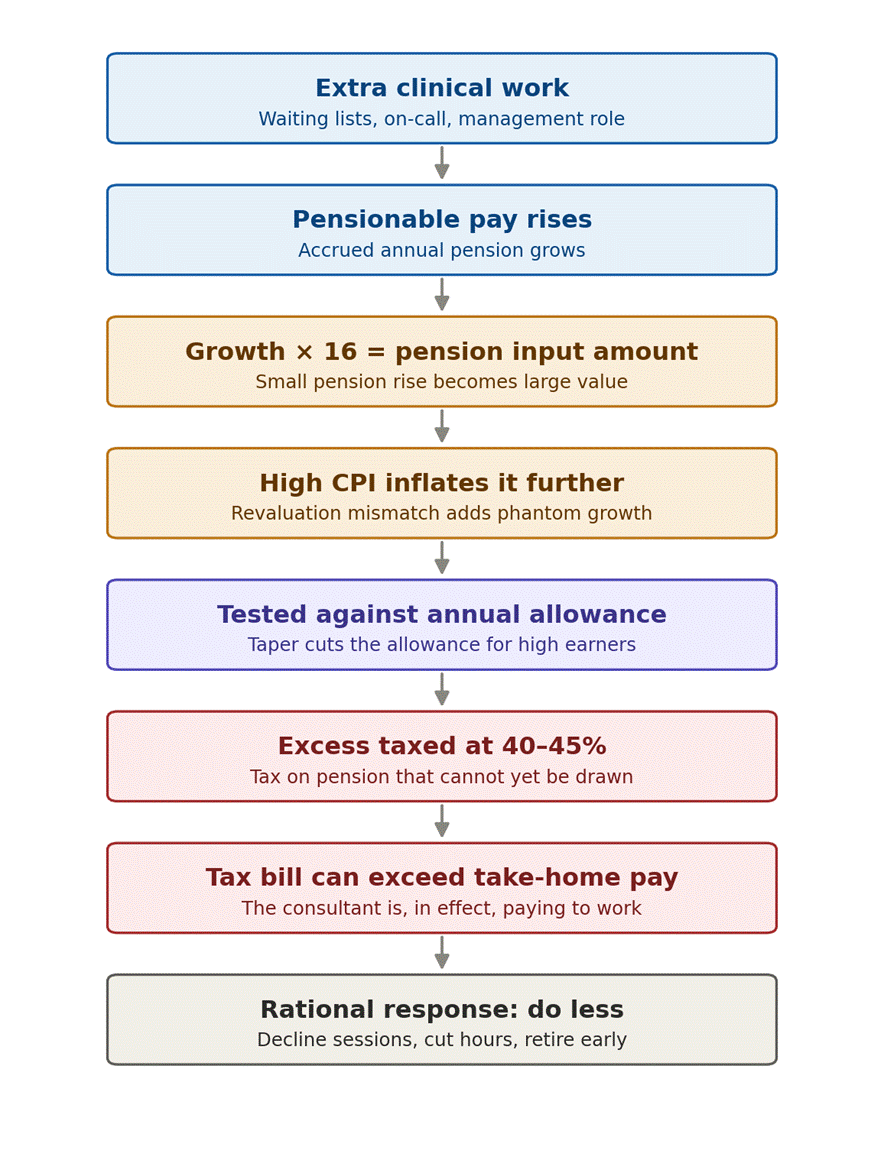
Figure 3. How extra clinical work could produce a tax charge larger than the take-home pay it generated.
But that genuine injustice became a shield for a second, weaker grievance: the objection to there being any cap at all on tax-free pension accrual. The annual allowance is simply the ceiling on how much pension everyone — public and private — may build tax-free in a year. For the portion of a senior public servant’s accrual that represents real growth, taxing the excess above the cap is not a scandal. It is the same rule that applies to a private-sector saver who tries to shelter too much in a single year. The difference is that the public servant’s accrual, valued honestly at sixteen times, is so large that it breaches the cap routinely — which tells you not that the cap is unfair, but how generous the underlying benefit is.
The distinction between the two grievances can be made exact. Take one consultant — an opening accrued pension of £55,000, pensionable pay of £110,000, total taxable income of £120,000 — and hold every one of those figures constant while changing only the year. In a normal-inflation year the calculation produces a pension input amount of about £63,000 and a tax charge near £18,000. In the high-inflation year of 2022, with the revaluation timing defect intact, the same person’s input amount balloons to nearly £135,000 and the charge to almost £46,000 — for identical work. Now correct only the inflation-netting, so that the opening balance is uprated by the same inflation figure that revalues the closing balance, and nothing else changes. The charge collapses to around £2,600. That single adjustment removes more than nine-tenths of the crisis-year bill, which tells you precisely how much of it was tax on inflation rather than tax on genuine growth.
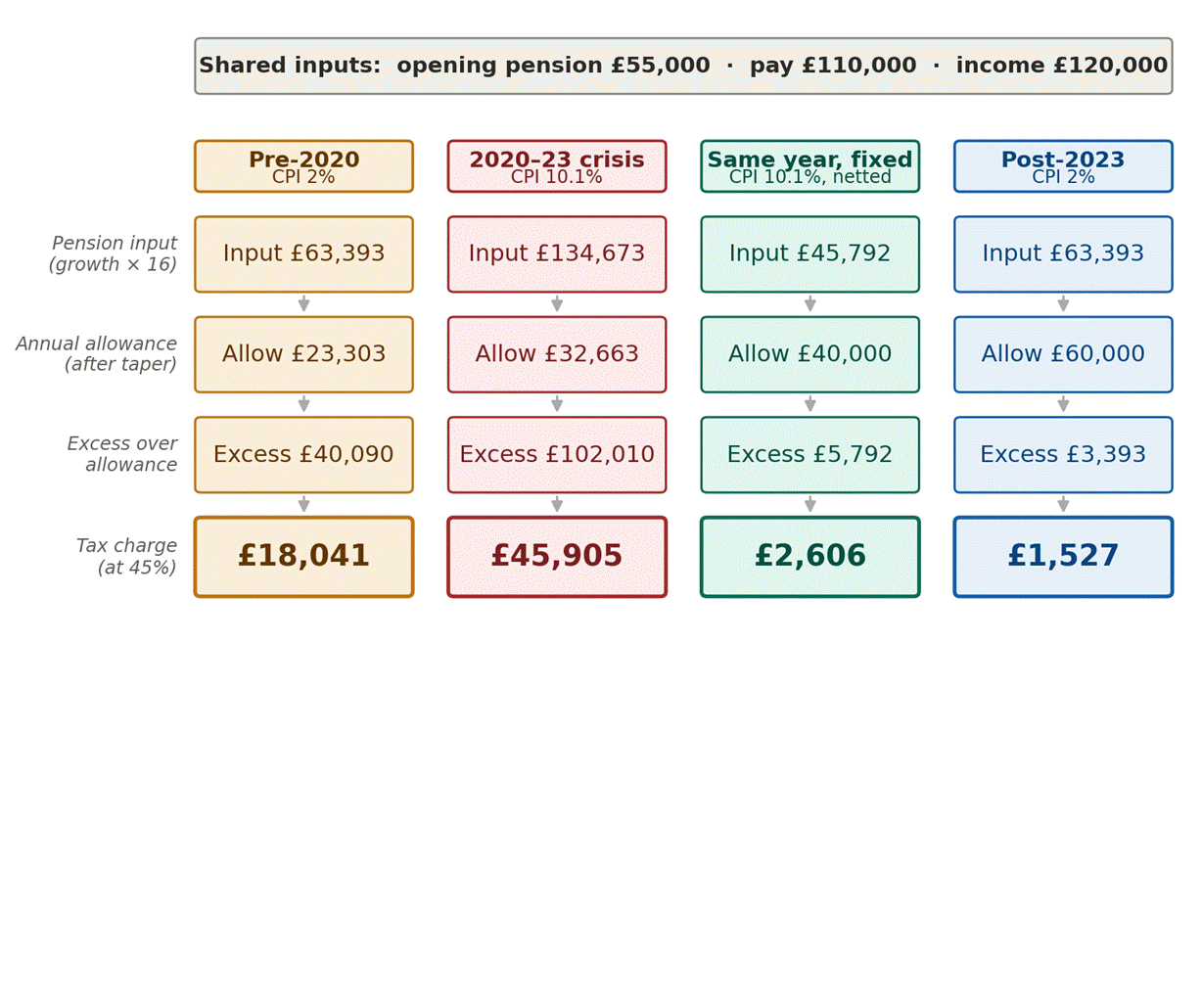
Figure 4. The same consultant in four scenarios. Holding work, pay and income constant and correcting only the inflation-netting (teal) cuts the crisis-year charge from £45,905 to £2,606.
This is the line the furore blurred. The residual £2,600 is tax on real growth above the cap, and it is arguably correct. The £43,000 that the netting fix removes was never a tax on benefit at all; it was a tax on the pension merely keeping pace with prices. One was an injustice and was fixed in 2023. The other was the annual allowance doing its job. Conflating them turned a precise, winnable argument about inflation into a vaguer, weaker one about whether senior public servants should face any cap at all.
The judiciary, tellingly, secured the outcome the doctors wanted. The Judicial Pension Scheme 2022 was deliberately made tax-unregistered, placing it entirely outside the annual allowance. Judges accrue the most generous pension of all the major schemes, and uniquely face no annual limit on doing so. Whatever the merits of retaining senior judges, it is hard to present this as anything other than one profession writing itself an exemption from a rule that binds everyone else.
The behavioural problem is real — and separate
There is a genuine policy tension here that no amount of arithmetic dissolves. Even where an annual allowance charge is fair in principle, it can be counterproductive in practice. If the marginal tax on a consultant’s extra theatre list exceeds the take-home pay from it, the consultant rationally declines the list, and the waiting list grows. A state that needs clinical work done cannot be indifferent to a tax that stops it being done, even a justified one.
But this is an argument about the design of the cap and the perverse incentives at the margin. It is not an argument that the underlying benefit is anything other than extraordinarily valuable. The two questions — “is this benefit generous?” and “does taxing its excess discourage work?” — have been allowed to collapse into one, and in the collapse the first question quietly disappeared. Both deserve answering on their own terms. The benefit is generous, by any honest measure. And the cap, as designed in the high-inflation years, did discourage exactly the work the country needed. Fixing the second should never have been allowed to retire the first.
Proximity to the pen
If the schemes are all built on the same template, why is the judiciary’s so much more generous than the nurse’s? Rank them by accrual and a pattern emerges that has nothing to do with the value of the work.
|
Scheme |
Accrual rate |
Active revaluation |
Normal pension age |
Member contributions |
Annual allowance? |
|
Judiciary (JPS 2022) |
1/40 (2.50%) |
Per scheme rules |
State Pension age |
Uniform rate |
Exempt |
|
Civil Service (alpha) |
~1/43 (2.32%) |
CPI |
66–67 |
~4.6–8.05% |
Applies |
|
Armed Forces (AFPS 15) |
1/47 |
CPI + 1% (+ AWE) |
60 |
None |
Applies |
|
NHS (2015) |
1/54 |
CPI + 1.5% |
67 |
up to ~12.5%+ |
Applies |
|
Teachers (CARE) |
1/57 |
CPI + 1.6% |
State Pension age |
~7.4–11.7% |
Applies |
Table 1. The five major reformed public-service schemes. All are defined benefit, career-average and unfunded; only the judiciary sits outside the annual allowance.
The judiciary accrues fastest, at one fortieth of pay each year, and uniquely sits outside the annual allowance entirely. The civil service follows close behind at roughly one forty-third. Then the armed forces at one forty-seventh, the NHS at one fifty-fourth, and teachers at one fifty-seventh. The ordering correlates almost perfectly with one variable — and it is not skill, scarcity, or social contribution. It is proximity to the machinery that writes and interprets the rules.
The judiciary occupies a constitutional position no other profession can match: it can convert a grievance directly into a binding ruling against the government, decided by its own members. When the 2015 reforms were found to have discriminated against younger members, the case that struck them down originated in judicial pension litigation and was decided by judges; every other profession was a beneficiary of that ruling, not its author. A surgeon who believes their pension tax is unjust can write to their union, strike, or resign. A judge who believes the same can hear the case. That asymmetry is structural and close to absolute. Doctors had to persuade power; judges were a branch of it.
The civil service sits second for a related reason: the schemes were designed by the Treasury, whose own staff are members of the civil service scheme. It would be uncharitable to call that self-dealing and naive to ignore it. The department setting the parameters for everyone’s pension had a direct interest in one particular outcome, and that scheme’s terms are notably comfortable.
The professions at the bottom of the table — the NHS and teaching — are the largest, most numerous workforces, with the most diffuse representation and the least individual leverage. The generosity gradient tracks bargaining power, not need or contribution. A nurse and a judge are both public servants underwritten by the same taxpayer. The judge accrues half as fast again and faces no cap; the nurse accrues more slowly and was caught by the very limit the judge escaped. The closer a profession sits to the pen and the gavel, the better it did.
Disarmed by the oath
There is a final asymmetry, and it is the cruellest, because it turns a profession’s greatest asset into the source of its weakness.
The power a profession holds in a negotiation is not simply whether it has a credible threat. It is whether that threat can be used without the using of it destroying the profession’s standing. And here doctors and judges sit at opposite poles.
A doctor’s ultimate leverage is to withdraw care. But the entire moral identity of medicine — the vocation, the duty to the patient, the public image of self-sacrifice — is built on never doing precisely that. The moment a doctor reaches for their strongest weapon, they are seen to betray the thing that gives the profession its prestige. The leverage is real, but pulling the trigger inflicts a self-wound. Every recent strike has played out this way: genuine grievance, real disruption, and a relentless framing of abandonment. The weapon fires backwards as much as forwards. And the public holds doctors to this standard with an intensity reserved for no one else; we do not condemn a striking train driver the way we condemn a striking doctor, because we have sacralised the medical vocation specifically. That reverence is a gift in normal times and a trap in a dispute — the higher the pedestal, the further the fall. The profession’s prestige and its powerlessness flow from the same source.
The judiciary has the inverse property. Its leverage is exerted through absence and inaction — senior practitioners simply declining to come forward, posts going quietly unfilled. There is no dramatic act, no visible withdrawal, no named victim. A High Court vacancy has no patient lying untreated. No oath is seen to be broken when a barrister chooses to remain in chambers. The pressure is applied at zero reputational cost. Nobody writes a headline accusing a barrister of selfishly declining the bench.
So the asymmetry is not that judges have more power and doctors less. It is that judges hold power that is costless to use, while doctors hold power that is ruinous to use. A weapon that cannot be fired without wounding the one who holds it is barely a weapon at all. The generosity gradient inversely tracks the moral price each profession must pay to assert itself — and medicine sits near the bottom precisely because its leverage is the most self-destructive to wield. It is not that judges abuse a freedom doctors lack. It is that the architecture hands one profession leverage it can spend for free, and hands the other only leverage it must bleed to use.
Equal before the law, unequal before the code
The judicial exemption deserves to be examined on its strongest defence, not its weakest, because it survives the strongest defence and that is what makes it damning.
Take every legitimate point in the government’s favour, and grant it in full. First, the cost. There are a few thousand senior judges and well over a million NHS staff; exempting the former from the annual allowance costs the Exchequer relatively little, while exempting the latter would cost billions and could not responsibly be done. That is true. Second, the history. Judges sat on tax-unregistered schemes for most of their modern existence; the 2022 scheme restored a prior arrangement rather than inventing a new privilege from nothing. That is true. Third, the pay cut. A successful barrister joining the bench usually forgoes far higher private earnings, so the case for bridging that gap has more force than it does for a consultant on a national pay scale. That, too, is true.
Now notice what survives.
The cost argument is not an argument about value. It is an argument about affordability. Stated honestly, the government’s position is not “judicial work is so vital it justifies an exemption” but “there are few enough judges that exempting them is cheap.” Those are entirely different claims, and only the first was ever offered in public. The moment the real reason is named, the merit framing collapses: the exemption was granted because it was inexpensive, not because the work was uniquely valuable — and a surgeon, whose scarcity matches a judge’s and whose absence kills, is left inside the cap not because their work matters less but because there are more of them.
The history argument cuts the same way. The 2015 reforms deliberately ended the judges’ tax-unregistered status, placing them on the same footing as everyone else. The 2022 scheme deliberately reversed that — for judges alone — after a recruitment crisis. A privilege restored selectively, while every other profession was left inside the registered regime, is still a privilege granted selectively. That it once existed does not explain why it was returned to one profession and withheld from the rest.
And the pay-cut argument is a difference of degree, not of kind. Doctors forgo private and overseas earnings to remain in the NHS in their thousands; the retention crisis is the proof that the bridge is not holding for them either. If the principle is that the state must remove a pension-tax barrier to keep scarce, high-value people in public service, then the principle is general. Applied to judges and refused to surgeons, it is not a principle at all. It is a rationalisation dressed as one — and the thing it rationalises is leverage.
This is the heart of it. The annual allowance exists to stop the highest earners sheltering unlimited income from tax through their pensions. The judiciary — among the highest-earning public servants in the country — is the single group explicitly placed beyond that anti-avoidance cap. No impropriety need be alleged, and none is. The discomfort is structural, and it is sharper for being structural: the profession entrusted with applying the law equally to every citizen has been granted a tax position available to no other citizen. Equality before the law and equality before the tax code, which the same people are meant to embody, visibly part company — and they part company in favour of the people doing the embodying.
The fault is not the judges’. They did not write the rule; they benefited from it. The fault is in an architecture that lets the professions closest to the pen and the gavel secure terms the professions that merely serve the public cannot, and then justifies the result with a principle it has no intention of applying to anyone who lacks the power to demand it. That is the unfairness, stated at its narrowest and least deniable. It is not that the system rewarded the wrong people. It is that it rewarded proximity to itself, and called it merit.
What honest accounting would change
None of this requires concluding that public servants should lose their pensions, or that defined benefit provision is wrong, or that those who serve the state deserve less. It requires only that the value of what is provided be stated plainly, in numbers, before the country decides what it thinks.
At present the debate runs the other way. The benefit is described in language designed to make it sound modest — “career average,” “reformed,” “a small slice each year” — while its true capital-equivalent value, three to seven times the private-sector norm and rising faster than inflation every year, never enters the conversation. When even a partial clawback provokes the reaction it did in 2022, that is not evidence of injustice. It is evidence of how completely the scale of the subsidy has been normalised by being kept out of sight.
The factor of sixteen is not a weapon. It is a torch. Shine it on these schemes and the invisible becomes visible: a guaranteed, indexed, taxpayer-underwritten transfer of value, paid disproportionately by a private-sector workforce that lost the same protection a generation ago and was never offered it back. One can defend that arrangement. One can argue that those who serve the public deserve security in old age, that recruitment and retention demand it, that a civilised state should provide it.
But one cannot defend it honestly while refusing to count it. And for thirty years, that is precisely what the debate has done.
The author is a Fellow of the Institute and Faculty of Actuaries.