The Triple Lock - Part 1 - The Ratchet
What the triple lock actually is, what it isn’t, and why both sides of the debate keep arguing about the wrong thing
Few phrases in British policy debate are repeated more often, or understood less precisely, than “the triple lock.” It is invoked by pensioner groups as a sacred guarantee, by younger commentators as an emblem of intergenerational unfairness, and by professionals from doctors to teachers as a label they often pin to grievances that have nothing to do with it. Most of these arguments would benefit from agreeing first what the triple lock actually is. So let us start there.
What the triple lock is
The triple lock is a formula. It governs how much the State Pension rises each April. Nothing more, nothing less. Each year, the government compares three figures and applies the highest of them to the new State Pension:
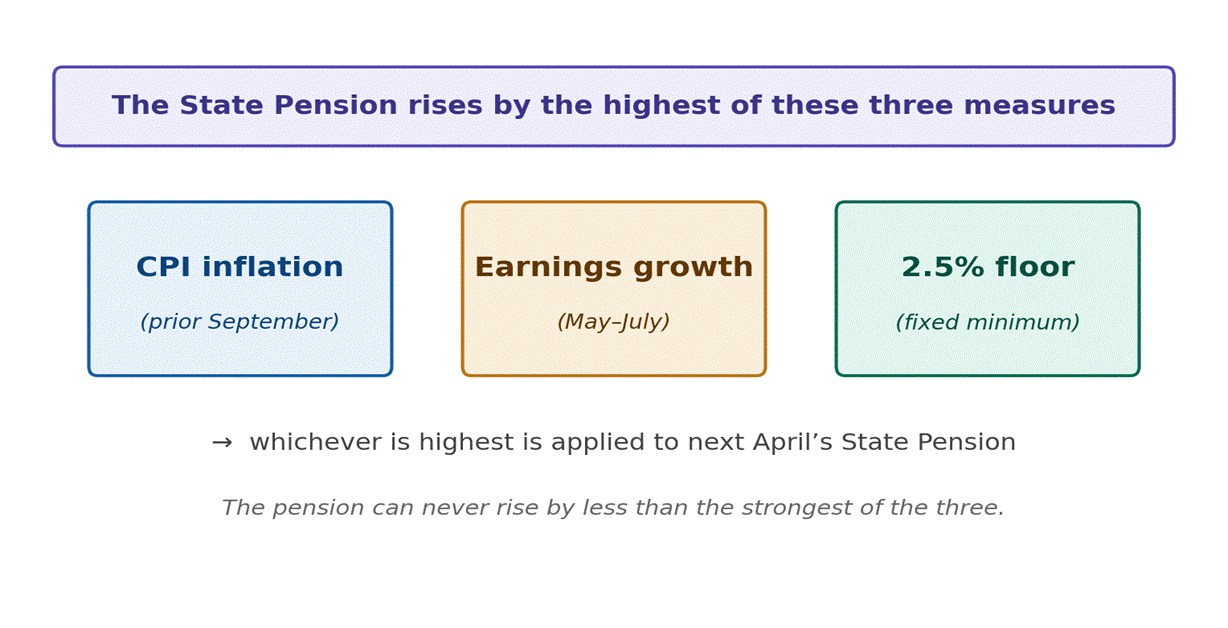
Figure 1. The triple lock formula. Each April, the State Pension rises by whichever of these three measures is highest.
The three measures are: CPI inflation as published for the previous September; average weekly earnings growth for the May-to-July window; and a fixed minimum of 2.5%. Whichever is highest in any given year wins. The pension can never rise by less than the strongest of the three, which is the “lock” in the name. “Triple” simply reflects that there are three measures locked together.
Before the triple lock, introduced by the coalition government in 2010 and first applied in April 2011, the State Pension rose only with prices — and earlier, before 1980, with earnings. The earnings link had been broken by the Thatcher government, and over thirty years the pension drifted steadily lower relative to wages, contributing to a serious problem of pensioner poverty by the 2000s. The triple lock was the cross-party response: a ratchet designed so that the State Pension would never again be allowed to fall behind on any of the three measures that matter.
What the triple lock is not
Because the word “pension” carries so much weight, the triple lock gets blamed for, and credited with, a great deal that has nothing to do with it. Three clarifications are worth making explicit, because almost every confused version of the debate trips on at least one of them.
It is not an occupational pension rule. The triple lock applies to the State Pension only — the flat-rate benefit funded by National Insurance and paid by the DWP. It does not govern the NHS pension, the Teachers’ Pension Scheme, the Civil Service alpha scheme, the armed forces scheme, or any private workplace pension. Those have their own revaluation rules. So a doctor or teacher who says they are being penalised “because of the triple lock” is almost always describing something else — typically the annual allowance tax charge that affected senior NHS clinicians in 2022, which arose from CPI mechanics in the NHS scheme, not from the triple lock. The triple lock and high CPI shared a common driver in that year, but only one of them taxed anyone. The triple lock simply raised the State Pension that the same doctor would, in due course, receive on identical terms to every other citizen.
It is not a transfer that excludes the young. Every National Insurance contributor today will, if the policy survives, benefit from the triple lock when they retire. It is intergenerational only in timing, not in entitlement — today’s workers fund today’s pensioners on a pay-as-you-go basis, and will themselves be funded by tomorrow’s workers. The legitimate concern is not that the young are excluded but that the formula compounds: an indefinitely-ratcheted benefit accruing to one cohort imposes a steadily rising claim on the next, and so on. That is a real concern, but it is not the same as a deliberate exclusion.
It is not a measure of pension generosity. The UK State Pension, even after fifteen years of ratchet, remains comparatively modest by international standards. The 2025 full new State Pension was around £11,975 a year; the equivalent in Germany, France, the Netherlands or Spain is typically higher, sometimes substantially. Critics of the triple lock often elide “the State Pension has risen rapidly” with “British pensioners are doing very well,” but those are different claims and only the first is unambiguously true. The pension has risen quickly from a low base.
Fifteen years of ratchet
The simplest way to see what the triple lock has actually done is to look at which of its three measures was binding in each year since it took effect. The pattern reveals both its design logic and its political vulnerability.
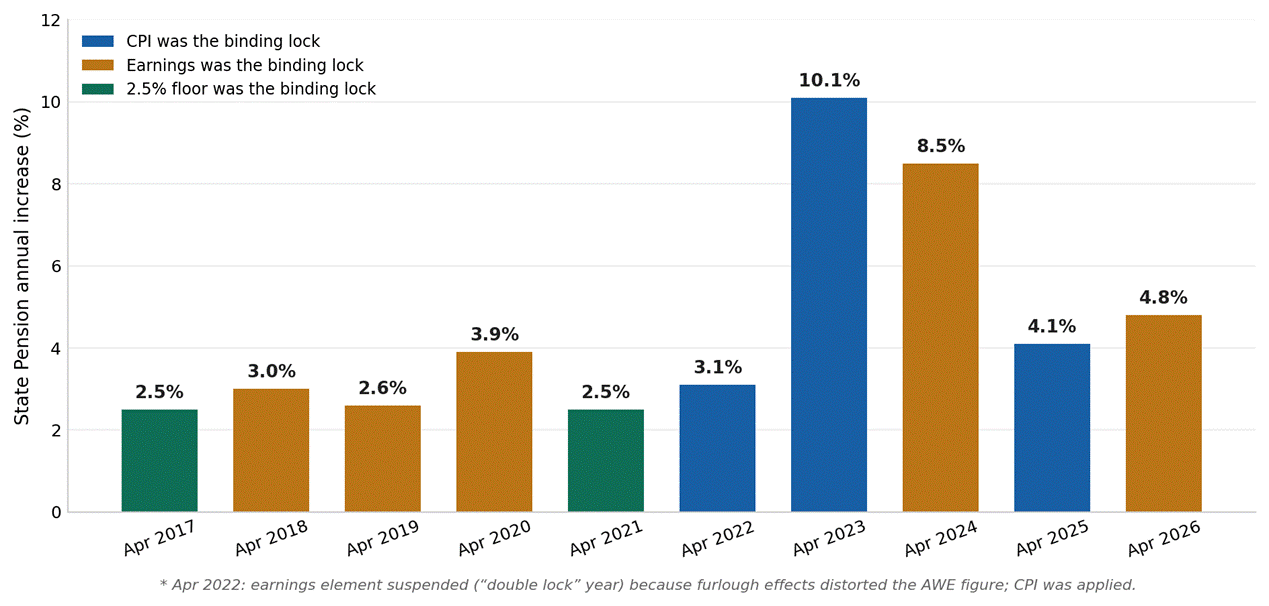
Figure 2. State Pension annual increases since 2017 and the binding lock in each year. The 2022 “double lock” year suspended the earnings element due to furlough distortion.
Across the period, no single measure dominates. In several years the 2.5% floor was binding, when both inflation and earnings growth were below it. In others earnings growth set the rate; in a smaller number CPI did. The two outliers — April 2023 and April 2024 — are the years that gave the policy its current political prominence: a 10.1% increase driven by post-pandemic inflation, followed by an 8.5% increase driven by the wage rebound. Together those two years added more to the State Pension in cash terms than the preceding decade combined, and brought the Treasury’s long-run forecast bill for the policy to a level the Office for Budget Responsibility now flags as a structural pressure on the public finances.
One year deserves a specific note. April 2022 is shown as a CPI year, but it was technically a double lock: the earnings element was suspended for that uprating because the May-to-July 2021 wage figure was distorted by workers returning from furlough, which produced an artificial 8.3% headline that nobody believed reflected genuine pay rises. Parliament passed one-off legislation removing earnings from the comparison for that year alone, and the pension rose by CPI of 3.1%. The triple lock has otherwise been applied without modification in every year of its existence.
The case for keeping it
The honest case for the triple lock is stronger than its critics tend to allow.
It corrected a real historical injustice. Between 1980 and 2010, the State Pension fell from roughly 25% of average earnings to under 20%, with pensioner poverty rates that by international comparison were striking for a wealthy country. The triple lock has reversed that trend; the pension is now back to around 25% of earnings, broadly where it sat before the earnings link was broken. Whatever its long-run sustainability questions, the policy did what it was designed to do.
It protects against a specific asymmetric risk. Pensioners cannot return to the workforce to make up lost income; a wage-only or prices-only link can produce real-terms declines in a bad year that retirees have no way of offsetting. The triple lock builds in a one-way ratchet that prevents that downside, at the cost of accepting that the upside is also one-way. For a population that has by definition stopped earning, that asymmetry has a defensible logic.
And it is politically transparent. Voters know what it is and know what they are voting for. Whatever one thinks of the policy, it is not concealed in the way that, say, public-sector defined benefit accrual is concealed. Both major parties have committed to maintaining it through the current parliament, and the political cost of breaking that commitment remains high.
The case against keeping it
The case against is also stronger than its defenders tend to allow.
The mathematics of a one-way ratchet are unforgiving over long horizons. The Institute for Fiscal Studies has shown that between 2010 and 2023 the State Pension rose 60% in cash terms while prices rose 42% and earnings rose only 40% — a cumulative real-terms uplift relative to working-age incomes that, projected forward several more decades, becomes a significant share of GDP. The OBR’s long-run fiscal projections treat the triple lock as one of the structural drivers of an unsustainable trajectory for the public finances.
It is also poorly targeted. The triple lock applies equally to every State Pension recipient, regardless of total retirement income. A pensioner with substantial private wealth, a defined benefit occupational pension, and the State Pension receives the same percentage uplift as a pensioner with only the State Pension to live on. As an anti-poverty measure it is therefore inefficient, channeling a meaningful share of its cost to people who do not need it. The same fiscal envelope, applied through a means-tested pensioner benefit or a higher Pension Credit, would reduce pensioner poverty more effectively.
And the ratchet has an internal flaw exposed in the high-CPI years of 2022 and 2023. Because the formula picks the highest of three, episodic spikes in any one measure become permanently embedded in the base. The 10.1% increase of April 2023 was driven by what almost everyone now agrees was a transitory inflation shock, but the elevated base it produced is permanent. Every subsequent percentage rise compounds on that higher base. Critics call this “ratchet asymmetry”: temporary inflation produces permanent uplifts, with no symmetric mechanism for stepping back down when conditions normalise.
The argument both sides keep missing
The most useful observation about the triple lock debate is that it is conducted almost entirely without reference to what the State Pension should be. The triple lock is a formula, but the real question is a target: what level of State Pension, relative to earnings or to a poverty threshold, does the country actually want to provide? Once that target is named, the choice of formula to reach and maintain it becomes a technical question. Without it, the debate is reduced to defending or attacking a mechanism while the destination it is supposed to reach goes unstated.
This is why the policy survives. Neither side can name the alternative. “Abolish the triple lock” sounds like cutting pensioner income, which no party wants to defend in an election. “Keep the triple lock indefinitely” sounds like accepting an unsustainable trajectory, which the OBR will not let anyone forget. The result is a policy that everyone privately doubts and nobody publicly opposes — sustained because the political cost of changing it exceeds the long-run cost of keeping it, until at some point that ranking flips.
The cleaner debate, if anyone wanted to have it, would proceed in two stages. First, set a target: the State Pension should be no less than X% of median earnings, or should ensure a single pensioner is no more than Y% below the poverty line, or some similar anchor. Then design the uprating rule that gets there and holds there — which might be a smoothed earnings link, a CPI-plus measure, a target-based catch-up, or indeed something resembling the current triple lock with explicit review triggers. The mechanism follows the target; the current debate has the mechanism without the target, which is why it makes so little progress.
And the doctors’ grievance, since this is where the confusion starts
A short note for the audience that often arrives at this debate angry. When senior NHS doctors said in 2022 and 2023 that they could not afford to work additional sessions “because of the triple lock,” they were almost always describing something else — the annual allowance tax charge on their NHS occupational pension, made acute by the same high inflation that drove the triple lock that year. The triple lock raised their future State Pension, which is a benefit. It did not tax them. The thing that taxed them was the cap on tax-free pension accrual in the NHS scheme, distorted by a timing defect in how inflation was netted from the calculation. The triple lock and the annual allowance crisis shared a common driver — high CPI — but only one of them produced a tax bill. Conflating them, as much of the press did at the time, turned a precise and winnable argument about inflation-netting into a vaguer and weaker one about whether pensioners were doing too well.
That is, in microcosm, the difficulty of the whole triple lock debate. It is a simple formula, but it sits in proximity to other parts of the pension system that look similar, share inputs, and produce different effects. Distinguishing them is most of the work. Once they are distinguished, the actual policy question — what level of State Pension we want and what mechanism should keep it there — becomes tractable. Without that distinction it is just noise, with each interested party using the same words to mean different things, and the answer drifting further out of reach with each round.